When a crisis hits, you have minutes — not days — to control the narrative. Bold Thinkers Group has been inside more than 50 crisis engagements, and the organizations that fared worst had one thing in common: no documented plan.
Why Most Crisis Plans Fail Before a Crisis Starts
A crisis communication plan is not a binder collecting dust on a shelf. It is an operational document — one that tells your team who speaks, what they say, and in what order, within the first 60 minutes of an incident.
HubSpot research consistently shows that organizations with documented communication processes respond faster and recover faster. That applies directly to crisis response.
Most plans fail because they are too vague. They name a "communications team" without listing specific people. They reference "holding statements" without providing templates. They identify channels without defining who owns each one.
A usable plan closes every one of those gaps before the crisis begins.
The Core Structure: What a Real Example Looks Like
Here is the foundational architecture of a working crisis communication plan. Every element below should exist in your document.
1. Crisis Tier Classification
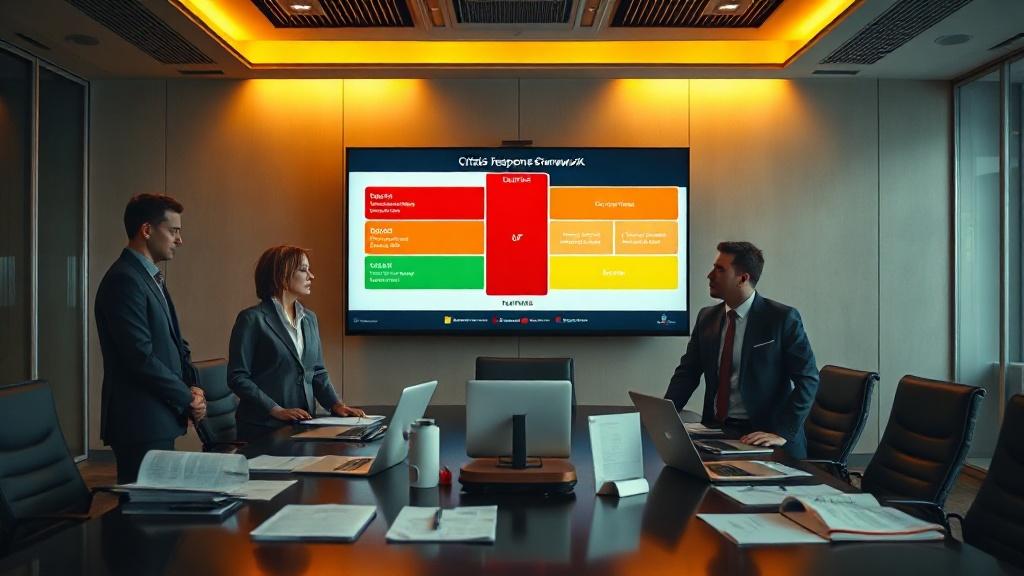
Not every incident is a Category 5 emergency. Tier your crises so your team knows how fast to escalate.
- Tier 1 — Low: Isolated complaint, minor service disruption. Response window: 24 hours.
- Tier 2 — Moderate: Media inquiry, regional incident, employee misconduct allegation. Response window: 4 hours.
- Tier 3 — Critical: Active emergency, legal exposure, viral negative coverage. Response window: 60 minutes or less.
2. The Crisis Response Team (CRT)
Your plan must name individuals — not job titles alone. Include a primary contact and a backup for each role. Every CRT should have at minimum:
- Incident Commander / Decision Authority — the person who approves all external messaging
- Primary Spokesperson — media-trained, authorized to speak on record
- Communications Lead — drafts statements, manages channel deployment
- Legal Liaison — reviews statements for liability before release (note: Bold Thinkers Group does not provide legal counsel; always retain separate legal representation)
- Operations Liaison — feeds real-time facts from the field
3. The First 60-Minute Protocol
According to FEMA's National Incident Management System guidelines, the first hour of an incident determines the trajectory of public perception. Your plan needs a minute-by-minute framework for that window.
A working example looks like this:
0–15 minutes: CRT activated. Incident Commander notified. Situation assessment begins.
15–30 minutes: Holding statement drafted and approved. Internal stakeholders notified before any public release.
30–45 minutes: Holding statement released across owned channels. Media inquiries routed to designated spokesperson only.
45–60 minutes: First media briefing scheduled if Tier 3. Monitoring of social and news coverage begins.
4. Pre-Approved Message Templates
This is the section most organizations skip — and it costs them dearly. Pre-approved holding statements reduce the approval cycle from hours to minutes.
A sample holding statement for a government agency or public organization in Hillsborough or Pinellas County might read:
"[Organization name] is aware of [incident description]. We are actively working to gather information and will provide a full update within [timeframe]. Public safety is our first priority. For questions, contact [designated spokesperson name] at [phone/email]."
That statement contains no speculation. It acknowledges the incident, signals action, and sets a follow-up expectation. It takes less than 10 seconds to read aloud and less than 2 minutes to adapt. That is the point.
Channel Strategy: Where and When You Communicate
A crisis communication plan example must specify channels — not just content. Different audiences live in different places.
For Tampa Bay-area organizations, a typical multi-channel matrix looks like this:
| Channel | Audience | Timing |
|---|---|---|
| Official website | General public, media | Within 30–45 minutes |
| Facebook / Meta | Community members | Simultaneous with website |
| Email / CRM | Existing clients or stakeholders | Within 1 hour |
| Press release via wire | Regional media outlets | Within 2 hours |
| Internal announcement | Staff | Before any public release |
Note that Meta's platform policies and posting protocols may affect how quickly statements distribute through boosted or paid amplification during emergencies. Plan for organic reach only in your first-hour window.
For organizations that serve St. Petersburg, Tampa, and the broader I-4 corridor, local media relationships matter as much as your channel mix. Your plan should include a pre-built media contact list with direct reporter emails — not just general newsroom numbers.
Steps to Take: Building Your Plan in 5 Concrete Actions
-
Audit your current crisis posture. Do you have a documented plan? When was it last updated? If the answer is "never" or "more than 2 years ago," start here.
-
Identify and train your spokesperson. A spokesperson with no media training is a liability. Most organizations need at least 4 hours of mock-interview preparation before they are ready for a hostile press conference. Our PIO training program is built around exactly this scenario.
-
Write your holding statements now. Draft 3–5 scenario-specific templates covering your highest-probability crises. A Florida municipality faces different scenarios than a private healthcare group — your templates should reflect that.
-
Map your stakeholder notification chain. Who gets told before the public? Board members, legal counsel, key funders, elected officials? That order matters. Stakeholders who hear about a crisis from a news alert before hearing from you will lose confidence fast.
-
Run a tabletop exercise. A plan that has never been tested is a draft. Run at least 1 tabletop simulation per year — 90 minutes, realistic scenario, every CRT member in the room. Government agencies in FL are often required to conduct exercises under state emergency management rules; private organizations should hold themselves to the same standard.
What a Sample Crisis Communication Plan Looks Like in Practice
Consider a hypothetical: a mid-size nonprofit in Tampa receives a complaint that goes viral on social media. Within 45 minutes, a local TV station has reached out for comment.
Without a plan, the executive director calls legal, legal says wait, the communications team drafts something too long, and three hours pass with no public response. By then, the story has been framed entirely by the complainant.
With a plan, the spokesperson releases a 2-sentence holding statement in 30 minutes. The communications lead monitors the thread. The Incident Commander decides within the hour whether to escalate to a press statement or let the holding statement stand.
McKinsey research on organizational resilience notes that organizations with clear decision-making protocols under stress perform measurably better during disruptions than those operating on improvisation. Crisis communications is a direct application of that principle.
The difference between those two outcomes is not talent. It is preparation.
Common Mistakes in Crisis Plan Examples
Even well-intentioned plans carry structural weaknesses. Watch for these:
- No secondary spokesperson named. If your primary is unavailable, who speaks? Plans that name only one person create single points of failure.
- Approval chains that are too long. A 5-person approval chain for a holding statement means nothing gets released in time. Limit statement approval to 2 people maximum during a Tier 3 event.
- No digital monitoring protocol. Your plan should name the tool (Google Alerts, a media monitoring platform, or a social listening dashboard) and the person responsible for watching it during an active incident.
- Missing dark site or backup communications channel. If your main website goes down during a crisis — which happens — where does the public go for information? Build a contingency page in advance.
- Plans written for legal protection, not operational speed. Some plans read like legal disclaimers. That serves no one in a fast-moving incident.
For organizations working on their fire department community outreach or broader public trust initiatives, a crisis communication plan is the floor — not the ceiling. Public trust built over years can erode in 48 hours without a structured response.
Effective crisis communication also requires you to understand how your stakeholders consume information. Organizations that have invested in harnessing social media analytics to propel small business growth already have a head start — you know where your audience is and how fast information moves through your channels.
And if your organization uses social platforms as a primary community touchpoint, your crisis plan needs to account for comment management, direct message volume, and platform-specific posting limits. Our post on what makes effective fire department engagement strategies covers the audience trust dynamics that apply across public and private sector organizations alike.
Frequently Asked Questions
Question: How long should a crisis communication plan be?
Answer: A functional plan is typically 10–20 pages. Shorter plans risk leaving critical gaps. Plans longer than 30 pages are often too complex to use under pressure. Prioritize operational clarity over comprehensiveness.
Question: How often should a crisis communication plan be updated?
Answer: At minimum, review your plan every 12 months. Update it immediately after any real incident, any significant leadership change, or any major shift in your organization's risk profile. For government entities in Florida, state and FEMA guidelines may require more frequent reviews.
Question: What is the difference between a crisis communication plan and a business continuity plan?
Answer: A business continuity plan covers operational recovery — how you keep functions running during a disruption. A crisis communication plan covers messaging — what you say to the public, media, and stakeholders during and after that disruption. They are related but distinct documents. Both are necessary.
Question: Do small businesses in Tampa Bay need a crisis communication plan?
Answer: Yes. A single negative news story, a viral social media post, or a public health incident can affect a small business as severely as a large organization. The scale of the plan may differ, but the structural elements — spokesperson, holding statement, notification chain — apply regardless of organization size.