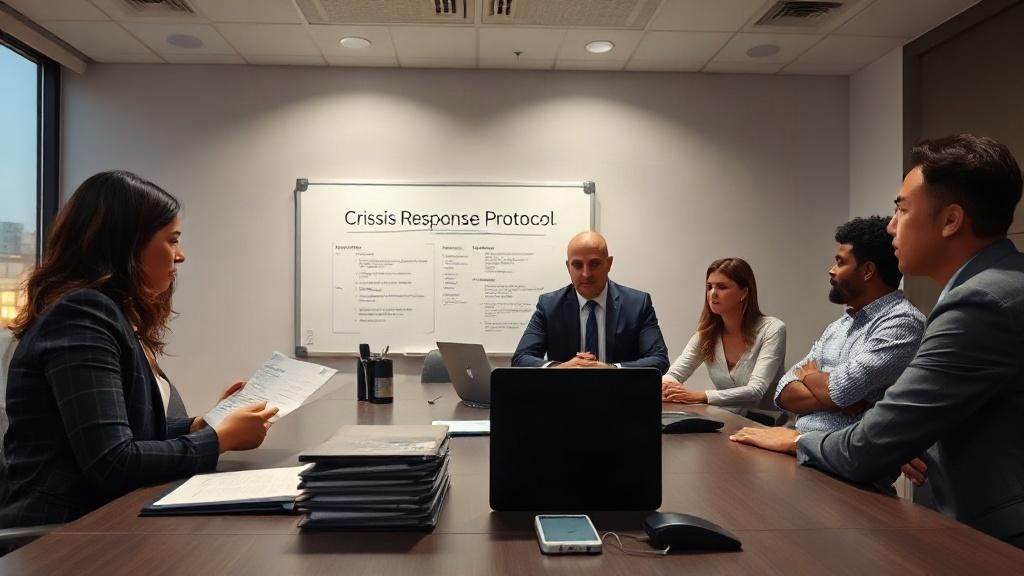
Most organizations in Tampa Bay don't fail during a crisis because they panicked. They fail because they had no plan — or their plan fell apart after the first 30 minutes. Bold Thinkers Group has worked through 50+ crisis engagements, and the pattern is the same every time: the organizations that hold the line are the ones who built their plan before they needed it.
This post walks through the core structure of a working crisis communication plan, using a real-world example framework so you can see what it looks like in practice — not just in theory.
Why Most Crisis Plans Fail Before the First Press Call
A plan that lives in a binder on a shelf is not a plan. It is a document.
The difference matters. According to FEMA's National Incident Management System (NIMS) guidelines, effective crisis communication requires pre-assigned roles, pre-approved message templates, and a clear command structure — all of which must be tested before they are needed. Organizations that skip the testing phase typically see their response time balloon past 4 hours, well beyond the 1-hour window in which HubSpot research suggests the public forms its initial opinion of how an organization is handling an emergency.
Most crisis plans also suffer from three structural problems:
- They identify a spokesperson but provide no media interview training
- They list communication channels but assign no one to monitor them
- They include holding statements from 3 years ago that reference people who no longer work there
If your plan has any of these gaps, the example framework below will help you close them.
The 5 Core Components of a Working Crisis Communication Plan
Every strong example of a crisis communication plan shares the same backbone. The details change by industry and organization size, but the structure does not.
1. Threat Assessment and Scenario Matrix
Before you write a single message, you need to know what you are planning for.
A threat matrix lists your 5 to 10 most likely crisis scenarios ranked by probability and severity. For a Hillsborough County municipality, that list might include a data breach, a public employee misconduct allegation, a natural disaster, or a facility failure. For a Pinellas County nonprofit, it might center on donor fraud allegations or a program safety incident.
Each scenario should have a corresponding severity level — typically a 3-tier system: Tier 1 (monitoring), Tier 2 (active response), Tier 3 (full activation). This keeps your team from treating a minor social media complaint the same as a federal investigation.
2. Designated Roles and Backup Assignments
Your plan must name names — not job titles.
When a crisis hits at 11:00 PM on a Friday, no one has time to figure out who the "Communications Director" is. The plan should list the primary spokesperson, a backup spokesperson, an internal communications lead, a social media monitor, and a legal liaison contact. Every role needs at least 1 backup assigned.
For organizations in Florida with public-facing obligations — government agencies, school districts, healthcare systems — this structure also aligns with FEMA's Joint Information System (JIS) model, which requires coordinated messaging across multiple agencies within the first 2 hours of a crisis event.
3. Pre-Approved Message Templates
Writing from scratch under pressure produces bad copy.
A sample crisis communication plan should include at least 6 pre-written holding statements — one for each major scenario in your threat matrix. These are not final statements. They are the first words out of your organization's mouth while you gather facts.
A holding statement for a data breach might read: "We are aware of a potential issue affecting [system]. We have activated our response team and will provide an update within 2 hours. The safety of our clients is our first priority."
That statement takes less than 60 seconds to send. It stops the information vacuum. It buys you time. And because it was pre-approved by legal and leadership, no one has to chase 4 signatures at midnight.
4. Channel Map and Escalation Protocol
Your plan needs to specify where you communicate, in what order, and to which audience.
A practical channel map might look like this:
- Internal staff: Direct message via secured platform within 15 minutes of Tier 2 activation
- Stakeholders and board: Email notification within 30 minutes
- Media: Designated press contact notified within 60 minutes; press statement issued within 2 hours
- Public/social media: Initial post within 90 minutes; updates every 2 hours until resolution
This kind of structure matters in Tampa, St. Petersburg, and across the Florida Gulf Coast where local media cycles move fast. A story that breaks at 6:00 AM can hit the noon broadcast if you do not respond by 9:00 AM.
For social media monitoring strategy during a crisis, see our post on Harnessing Social Media Analytics To Propel Small Business Growth.
5. Post-Crisis Debrief and Plan Update Protocol
The crisis is not over when the cameras leave.
Your plan should require a structured debrief within 5 business days of any Tier 2 or Tier 3 activation. That debrief should answer three questions: What went as planned? What broke down? What do we update before the next event?
McKinsey research on organizational resilience suggests that teams who conduct structured post-incident reviews are significantly more effective in subsequent crises because they close the gaps that pressure exposed the first time. Treating the debrief as optional means you will repeat the same failures.
What to Do: Build Your Plan in 5 Steps
Here is a concrete sequence for building your own crisis communication plan from scratch.
- Run a threat audit. List every scenario that could force you in front of a microphone in the next 12 months. Include reputational, operational, and external threats.
- Assign roles in writing. Name your spokesperson and 1 backup. Assign every other function to a specific person with a phone number attached.
- Write 6 holding statements. One per top scenario. Get legal and leadership sign-off before a crisis, not during one.
- Map your channels. Specify platform, audience, timing, and who hits "send" for each channel in your response sequence.
- Schedule a drill. Run a tabletop exercise within 60 days of plan completion. Gartner's research on crisis preparedness consistently shows that organizations that drill at least once per year respond 40% faster than those that do not.
For government communicators and public information officers, our PIO training program covers this structure in depth with FEMA MPIO-aligned curriculum.
What a Real Crisis Communication Plan Example Looks Like in Practice
Consider a mid-size healthcare provider in Hillsborough County that discovers a patient data exposure on a Tuesday morning. Without a plan, their first 4 hours typically look like this: leadership meetings, legal calls, finger-pointing, and silence toward the public.
With a working plan in place, the first 4 hours look different:
- 0:00–0:15: Tier 3 activated. Spokesperson notified. Legal liaison pulled in.
- 0:15–0:30: Internal staff notified via secured channel. Pre-approved holding statement reviewed and sent to communications lead.
- 0:30–0:60: Holding statement issued publicly. Media contact notified. Social monitoring activated.
- 1:00–2:00: Situation brief prepared. Spokesperson briefed. Second update issued.
The difference is not talent. It is preparation. Forrester has noted that organizations with formal crisis response protocols restore stakeholder trust an average of 3x faster than those responding ad hoc. That gap shows up directly in brand recovery timelines and revenue retention.
For community-facing organizations — fire departments, law enforcement agencies, government bodies — the stakes around public trust are even higher. See our post on Fire Department Community Outreach That Builds Trust for context on how communication shapes public perception before a crisis ever starts.
How AI Search and Digital Channels Change the Crisis Window
Your crisis is no longer just a media story. It is also a search result and a social thread.
Google surfaces news, social posts, and Reddit threads within minutes of a breaking story. If your organization's name is in a headline, someone will search it — and what they find in those first 3 hours shapes opinion for weeks. That is why your crisis communication plan must now include an AI search and digital visibility component: pre-built content that can rank fast, accurate social posts that dominate your branded search results, and a clear protocol for managing online narrative alongside traditional media.
This is an area where most sample crisis communication plans are 5 years behind current practice. Digital speed has compressed the acceptable response window from 24 hours down to under 90 minutes.
For context on managing your digital presence under pressure, see our post on How To Connect With Clients On Social Media Platforms.
Frequently Asked Questions
Question: How long should a crisis communication plan be?
Answer: Most working plans run 15 to 25 pages. Anything longer typically slows response time because people cannot find what they need under pressure. Include an executive summary on page 1 with the single most important action for each role.
Question: How often should we update a crisis communication plan?
Answer: Review your plan at minimum every 12 months and after any Tier 2 or Tier 3 activation. Staff changes, new platforms, and shifts in your operating environment can make a plan outdated within 6 months of writing it.
Question: What is the single biggest mistake in a sample crisis communication plan?
Answer: Failing to name a backup spokesperson. When the primary spokesperson is unavailable — traveling, ill, or part of the incident — organizations with no backup typically go silent for 2 to 6 hours. Silence is almost always interpreted as guilt or incompetence.
Question: Does a small business in Tampa Bay need a crisis communication plan?
Answer: Yes. A negative Google review that goes viral, a slip-and-fall claim, or a disgruntled employee posting on social media can generate a local media story within hours. Small businesses in Tampa, St. Petersburg, and across Pinellas County are not exempt from reputational crises — they just have fewer resources to absorb the damage when they have no plan.
If your organization does not have a tested crisis communication plan — or your current plan has not been reviewed in more than 12 months — schedule a free strategy session with our team. Call (813) 797-5004 or visit boldthinkersgroup.com. We will review your current posture and identify the gaps before a crisis does it for you.
Reviewed by thinkBOLD | Bold Thinkers Group