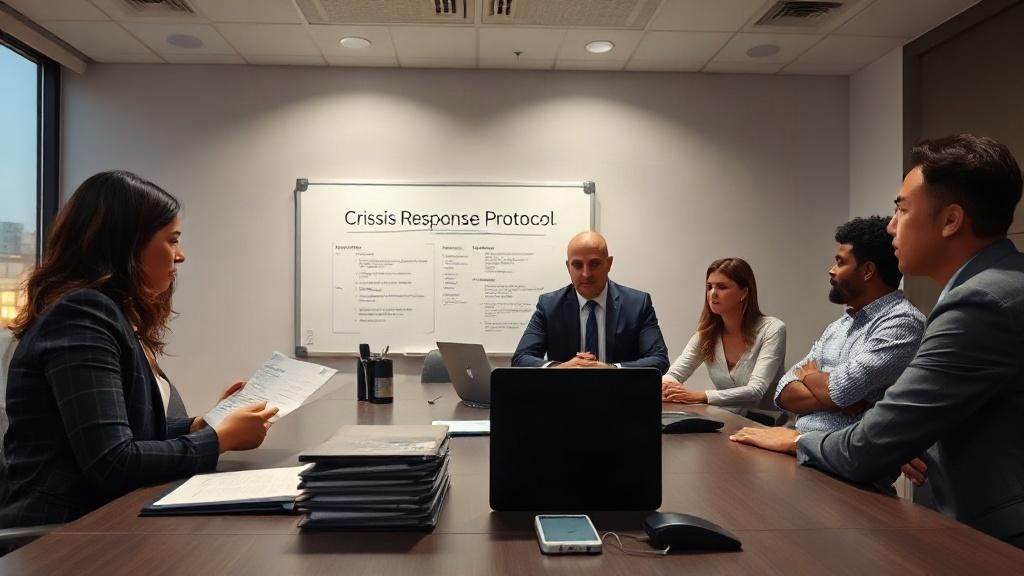
Most crisis plans sit in a shared drive, unread, until the moment they're needed most — and then they fail. Bold Thinkers Group has led 50+ crisis engagements across Florida and the country, and the pattern is almost always the same: the plan existed, but it wasn't built for execution.
This post gives you a working crisis communication plan example — structured for the way crises actually move, not the way they look in a PowerPoint template.
Why Most Sample Crisis Communication Plans Fall Short
A sample crisis communication plan fails for one of three reasons.
First, it treats every crisis the same. A data breach requires a different response than a workplace accident or a social media incident. A single generic template can't serve all three.
Second, it assigns roles without training the people in them. You can list a spokesperson on paper. That means nothing if they've never been in front of a camera during a crisis.
Third, it skips the first 60 minutes. Research from HubSpot shows that brand perception shifts fastest in the first hour of a public incident. If your plan doesn't account for that window, you're already behind.
A functional crisis communication plan example accounts for speed, clarity, and role-specific action — before anyone is under pressure.
The Core Structure of an Effective Crisis Communication Plan
Here is the structure we use. Every section serves a purpose. Nothing is decorative.
1. Crisis Classification Matrix
Before you communicate anything, you need to know what level of crisis you're facing. We use a 3-tier scale:
- Tier 1 — Localized incident with limited public exposure (internal, resolved within 24 hours)
- Tier 2 — Public-facing incident with media or social media attention (24–72 hours)
- Tier 3 — Reputation-threatening crisis with regulatory, legal, or sustained media involvement (72+ hours)
This classification controls everything downstream: who gets notified, how fast, and what gets said publicly.
2. Spokesperson Designation and Backup Chain
Name your primary spokesperson. Name two backups. Include direct cell numbers, not office lines.
During a Tier 3 crisis, your CEO may not be the right voice. Sometimes a department head or a trained public information officer is more credible for that specific incident. Make that call now, not at 11 p.m. when a reporter is calling.
3. Notification Cascade (First 60 Minutes)
Your notification cascade defines who learns what, in what order, in the first 60 minutes. This is not optional. FEMA's crisis communications framework requires government and public safety entities to establish exactly this structure.
A working cascade looks like this:
- Internal leadership notified (0–10 minutes)
- Legal counsel informed — not directing communications, just aware (10–20 minutes)
- Spokesperson briefed and drafted statement reviewed (20–40 minutes)
- Initial holding statement issued (40–60 minutes)
That holding statement doesn't need all the answers. It needs 3 things: acknowledgment, what you know now, and when you'll update.
A Real Example of a Crisis Communication Plan in Action
Here is an example of a crisis communication plan applied to a Tier 2 scenario: a Tampa Bay healthcare organization faces a social media post alleging patient negligence. The post gains 2,000+ shares within 4 hours.
Hour 1: Contain and Assess
The communications director activates the Tier 2 protocol. The spokesperson — in this case, a patient relations director with media training — is notified within 15 minutes. A social media hold is placed. No one posts anything while the facts are verified.
A holding statement is issued within 45 minutes: "We are aware of concerns raised online and are reviewing this matter with urgency. Patient care is our first priority, and we will share an update within 3 hours."
That's it. Simple, factual, and it stops the speculation gap from widening.
Hours 2–6: Investigate and Respond
The communications team documents the timeline of events. They identify whether the claim is accurate, partially accurate, or false. That finding shapes the tone of the full response.
If accurate: lead with accountability. If false: correct the record clearly, without attacking the person who posted.
The full response goes to three channels within 6 hours: the organization's website (as a press statement), the social media platform where the post originated, and a direct email to any media who contacted the organization.
Beyond 24 Hours: Monitor and Document
Every media inquiry is logged. Every social mention is tracked. This documentation matters — not just for this crisis, but for the post-incident review that should happen within 5 business days.
For more on how public sector organizations structure their community messaging after an incident, see our post on Fire Department Community Outreach That Builds Trust.
What to Do: 4 Steps to Build Your Own Crisis Communication Plan
These steps apply whether you're a Hillsborough County school district, a Pinellas nonprofit, or a St. Petersburg professional services firm.
- Audit your current plan. If it's more than 18 months old, it may not reflect your current team, channels, or risks. Review it now.
- Run a tabletop drill. Walk your team through a fictional Tier 2 scenario and clock how long it takes to issue a holding statement. If it takes more than 60 minutes, your plan has a gap.
- Train your spokespersons. Media interview training is not a nice-to-have. It is the difference between a 5-minute story and a 5-day news cycle.
- Pre-approve your message templates. Draft 3–5 holding statements for common crisis types your organization faces. When a crisis hits, a pre-approved template cuts your response time by up to 40%.
For organizations that use social media as a primary communications channel during incidents, Harnessing Social Media Analytics To Propel Small Business Growth covers how to monitor sentiment in real time. And if your team needs to sharpen its social content discipline before a crisis hits, Mastering Social Media Content Planning For Success gives you a framework to work from.
How AI and Digital Channels Are Changing Crisis Response
McKinsey research has noted that organizations with integrated digital monitoring catch reputational threats an average of 3–4 hours faster than those relying on manual tracking.
That gap matters. A 3-hour head start means your statement is out before the second wave of media coverage. It means you're shaping the narrative instead of responding to someone else's.
Tools like Meta's content monitoring systems and Google Alerts are not substitutes for professional crisis monitoring — but they are minimum baselines every organization should have running. If you have neither, set them up today. They cost $0 and take less than 30 minutes to configure.
Crisis communications is also where AI-assisted content has a hard limit. You cannot automate empathy. You cannot automate judgment calls about what facts to release and when. Trained human communicators — specifically those with public information officer credentials — still make those calls. See the full framework for how crisis communications services work at boldthinkersgroup.com/services/crisis-communications.
Who This Plan Is Built For
This example of a crisis communication plan is written for organizations that face real public accountability: fire service agencies, law enforcement, healthcare providers, school districts, and businesses operating in high-visibility markets like Tampa, Hillsborough County, and the broader Florida Gulf Coast region.
If your organization has more than 10 employees and serves the public in any way, you need a plan at this level of specificity. A two-page document that lists your PR firm's phone number is not a crisis communication plan. It's a false sense of security.
Frequently Asked Questions
Question: What should a crisis communication plan include at minimum?
Answer: At minimum, your plan needs a crisis classification system, a designated spokesperson with 2 backups, a notification cascade for the first 60 minutes, pre-approved message templates, and a post-incident review process. Plans without all 5 elements typically fail at the point of execution.
Question: How long should it take to issue a holding statement during a crisis?
Answer: A well-prepared organization should issue a holding statement within 45–60 minutes of confirming a crisis is public-facing. Anything beyond 90 minutes allows the narrative to form without your input, which is nearly always worse than an imperfect early statement.
Question: How often should a crisis communication plan be updated?
Answer: Review your plan every 12–18 months at minimum, or after any significant change to your leadership, communications team, or primary digital channels. Also update it immediately after any real crisis, while the lessons are fresh.
Question: Do small businesses in Tampa Bay need a crisis communication plan?
Answer: Yes. Small businesses in Hillsborough and Pinellas counties face the same social media speed and local media scrutiny as large organizations. A negative post or local news story can move faster than most small business owners expect. A basic Tier 1 and Tier 2 plan with pre-approved templates is achievable in a single planning session.
Ready to build a plan that actually works under pressure? Bold Thinkers Group offers crisis communication plan development rooted in FEMA MPIO-certified methodology — the same framework used by public safety agencies across Florida. Call us at (813) 797-5004 or visit boldthinkersgroup.com to schedule a strategy session. Don't wait for a crisis to find out your plan doesn't hold.
Reviewed by thinkBOLD | Bold Thinkers Group