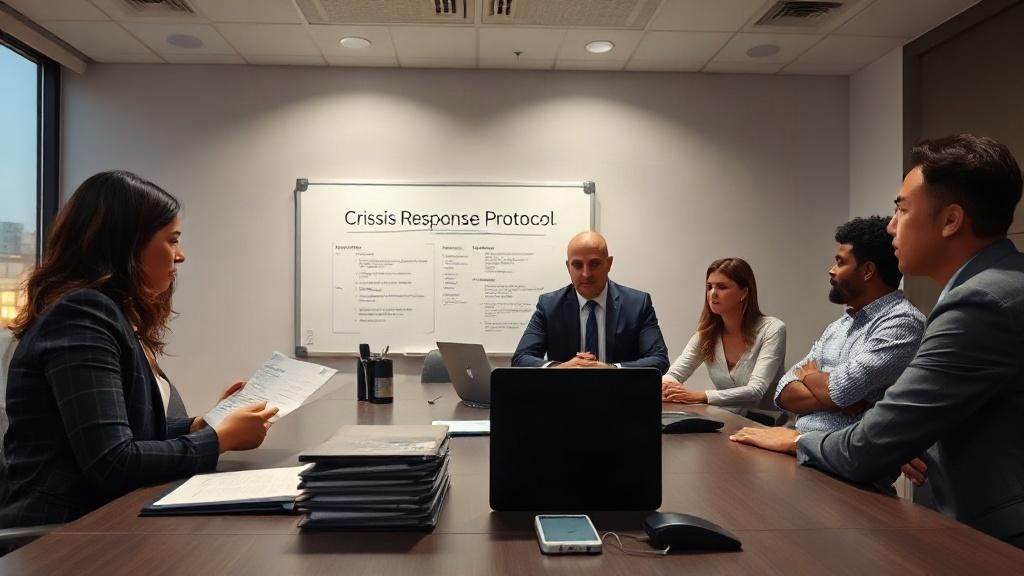
Most organizations don't fail in a crisis because they panicked. They fail because their plan was built for a boardroom presentation, not a real incident. Bold Thinkers Group has worked through 50+ crisis engagements — and the gap between a plan that holds and one that collapses under pressure is almost always structural.
This post breaks down what functional crisis communication plans actually contain, with real-world examples across industries.
Why Most Sample Crisis Communication Plans Miss the Point
You can find a sample crisis communication plan template in about 30 seconds online. What you won't find is one built around operational reality.
The plans that fail share 3 common problems:
- No spokesperson chain. When the primary contact is unreachable, the plan stalls within the first 15 minutes.
- Vague timelines. Saying "respond promptly" means nothing. A functional plan specifies response windows — typically 30 minutes for internal alerts, 60 minutes for first public statement.
- No pre-approved language. Waiting for legal to approve every word during a live crisis adds 2–4 hours to your first response — a delay that shapes public perception permanently.
According to FEMA's National Incident Management System (NIMS) guidance, coordinated communication during an incident requires pre-designated roles, not improvised decisions. That principle applies equally to private sector organizations.
What a Crisis Communication Plan Example Actually Looks Like
A strong plan has 6 core components. Each one should fit on a single page so your team can reference it under stress.
1. Threat Assessment Matrix
List the top 5–8 crisis scenarios most likely to affect your organization. For a Tampa Bay business, that list typically includes hurricane-related disruptions, data incidents, personnel crises, and operational accidents.
Assign each scenario a probability score (1–5) and an impact score (1–5). Multiply them. Scenarios scoring 15 or higher get a dedicated response protocol.
2. Spokesperson Designation and Backup Chain
Name one primary spokesperson and two backups. Include personal cell numbers — not office lines. Every hour of delay in reaching a spokesperson costs you control of the narrative.
3. Notification Sequence With Time Targets
Your plan should read like a timeline, not a checklist. For example:
- 0–15 minutes: Incident confirmed internally; leadership notified
- 15–30 minutes: Core crisis team assembled (in person or via call)
- 30–60 minutes: First internal communication issued to staff
- 60–90 minutes: First external statement issued (media, social, or direct stakeholder)
4. Pre-Approved Message Templates
Draft holding statements for your top 3 crisis scenarios before anything happens. A holding statement doesn't need to say everything. It needs to say three things: you're aware, you're responding, and you'll update within a specific timeframe.
5. Channel Strategy
Identify which channels you'll activate and in what order. For most Florida organizations, that sequence runs: direct stakeholder notification → owned social channels → media statement → website update.
HubSpot's research on communication channel usage shows that email remains the most reliable channel for direct stakeholder contact during disruptions — social platforms have algorithm-driven delays that can suppress urgent posts for 2–6 hours.
6. Post-Crisis Review Protocol
Schedule a structured debrief within 72 hours of incident resolution. Document what the plan got right, what it missed, and what changes are needed before the next review cycle.
Example of a Crisis Communication Plan: Fire Department Context
Fire departments and public safety agencies operate under a different standard. Their crisis communications must meet both public information requirements and NIMS ICS-702 protocols.
A functional public safety crisis communication plan example includes:
- A designated Public Information Officer (PIO) with backup coverage for 24/7 incidents
- Pre-approved language for fatality notifications, active incidents, and resource requests
- Social media monitoring protocols — because 68% of the public now reports using social media as a primary source during local emergencies, according to Pew Research Center
- Coordination checkpoints with Hillsborough County Emergency Management and Pinellas County public information offices when incidents cross jurisdictional lines
For fire service and law enforcement agencies across Tampa, St. Petersburg, and surrounding Florida counties, this level of coordination isn't optional — it's expected. Our PIO.Training program is built specifically for public safety communicators who need to operate at this standard.
For more on how fire agencies build community trust before a crisis hits, see Fire Department Community Outreach That Builds Trust.
Example of Crisis Communication Plan: Private Sector (Healthcare and Nonprofits)
A healthcare organization or nonprofit facing a crisis — staff misconduct, patient data concerns, funding loss — needs a plan that accounts for regulatory requirements alongside public messaging.
Key elements in this context:
Regulatory alignment: Know which agencies require notification and within what timeframe. In Florida, certain data incidents require notification within 30 days under state statute. Your plan must name the compliance lead and document this step explicitly.
Board and donor communication: Nonprofits often overlook internal stakeholders. A board member or major donor who learns about a crisis from a news report — before hearing from leadership — is a problem that compounds the original incident.
Media protocol: Designate who speaks to press and who does not. "No comment" is rarely the right answer. A holding statement that acknowledges the situation and commits to a follow-up is almost always better than silence.
McKinsey research on organizational crisis response has found that companies with pre-built response frameworks recover stakeholder trust measurably faster than those who improvise — with trust recovery timelines typically 40–60% shorter when a formal plan exists.
For organizations that want to align crisis communications with broader digital visibility, the connection between how you respond and how you're perceived online is direct. See Harnessing Social Media Analytics To Propel Small Business Growth for more on managing that relationship.
Steps to Build Your Own Crisis Communication Plan
Build your plan in this order. Don't skip steps — the sequence matters.
- Audit your top 5 risk scenarios. Be specific. "Reputational damage" is not a scenario. "Executive arrested on a Tuesday morning before a scheduled product launch" is a scenario.
- Name your crisis team. Assign roles in writing: decision-maker, spokesperson, legal liaison, communications lead, and social media monitor.
- Draft holding statements for each scenario. Keep them under 100 words each. Have legal pre-approve the language now, not during an incident.
- Set your response time targets. Write them as hard deadlines — 30 minutes, 60 minutes, 90 minutes — not as guidelines.
- Test the plan. Run a tabletop exercise at least once every 12 months. Test the spokesperson. Test the notification sequence. If it hasn't been tested, it hasn't been proven.
How Social Media Changes the Example of a Crisis Communication Plan
Google's own guidance on reputation management emphasizes that search results and social content shape public perception faster than any press release. Meta platforms — Facebook and Instagram — can surface crisis-related content to broad audiences within minutes of posting, regardless of whether that content comes from your organization or someone else.
Your plan must address:
- Monitoring: Who watches social channels during an incident, and how often?
- Response authority: Who can post without approval? What requires sign-off?
- Platform-specific timing: A statement posted to Facebook at 11 p.m. may reach your audience by 7 a.m. the next morning. Plan for the lag.
Social media is not a secondary channel during a crisis. It is often the first place your stakeholders look and the last place organizations think to prepare. See How To Connect With Clients On Social Media Platforms for tactical guidance on channel management.
Frequently Asked Questions
Question: What is the most important element in a crisis communication plan example?
Answer: Speed and clarity of the first response. Most experts and FEMA guidance agree that the first 60–90 minutes of a crisis set the tone for public perception. A plan that specifies who speaks, what they say, and when they say it is far more valuable than a lengthy document with no action timelines.
Question: How long should a sample crisis communication plan be?
Answer: Short enough to use under stress — typically 8–15 pages for a core plan, with scenario-specific appendices. A plan that runs 40+ pages often goes unread and unused when an incident actually occurs.
Question: Should our crisis communication plan cover social media specifically?
Answer: Yes. Every current plan should include designated social media response roles, pre-approved language for common scenarios, and a monitoring schedule. Platforms like Meta and X (formerly Twitter) can spread incident-related content to thousands of people within 15–30 minutes.
Question: How often should a crisis communication plan be updated?
Answer: Review the plan at least every 12 months and after any real incident or near-miss. Staffing changes, new communication channels, and shifts in regulatory requirements can make a plan outdated within a single year.