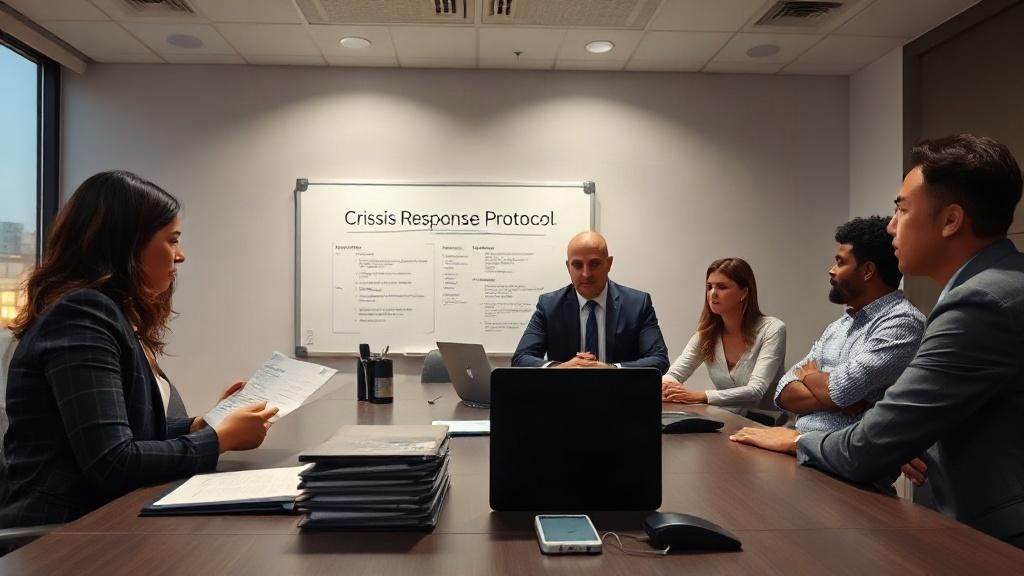
Most crisis communication plans fail at the worst possible moment — not because they were poorly written, but because they were never built for real-world pressure. Bold Thinkers Group has worked through 50+ crisis engagements, and the plans that hold up share a specific architecture. This post breaks that architecture down.
Why Most Plans Fall Apart in the First 60 Minutes
A crisis does not wait for your communications director to finish a meeting. It breaks on a Saturday at 11 p.m., or during a staff shortage, or while your CEO is traveling.
HubSpot research consistently shows that organizations without a documented response plan take 3–5 times longer to issue an initial public statement. That delay costs credibility.
The first 60 minutes of a crisis typically set the public narrative. If your organization is silent, someone else — a journalist, a witness, a disgruntled employee — fills that void for you.
A strong example of a crisis communication plan addresses this directly. It does not just list what to say. It defines who speaks, in what order, and within what timeframe.
The Core Structure: What a Sample Crisis Communication Plan Looks Like
A functional crisis communication plan has 6 core components. Each one serves a specific operational purpose.
- Threat assessment matrix — ranks likely crises by probability and impact
- Activation trigger protocol — defines what event starts the plan
- Core response team roster — lists names, roles, and 24/7 contact numbers
- Pre-approved message templates — initial holding statements ready to deploy within 30 minutes
- Channel-specific response protocols — different instructions for media, social, internal staff, and elected officials
- Post-crisis review checklist — a structured debrief process run within 72 hours of resolution
This is not a theoretical framework. This is the structure drawn from FEMA's Public Information Officer training curriculum, which forms the backbone of how government agencies at every level handle public communications during disasters and incidents.
For a deeper look at how public safety agencies use this model, see What Makes Effective Fire Department Engagement Strategies.
A Real-World Example Crisis Communication Plan in Action
Here is what an actual crisis communication plan example looks like when a mid-size Florida municipality faces a data breach affecting 14,000 residents.
Hour 0–1: Activate and Assess
The incident is confirmed at 9:47 a.m. on a Tuesday. Within 15 minutes, the communications director activates the plan using the pre-set trigger: "confirmed breach of resident PII affecting 500+ individuals."
The core response team — PIO, City Manager, IT Director, and Legal Counsel — is notified via a group text thread established before the crisis. Each person has a defined role. No one improvises authority they were not assigned.
Hour 1–3: Issue a Holding Statement
Within 45 minutes of activation, the PIO sends a holding statement to local media. It runs approximately 75 words. It confirms the agency is aware, says what it can say, and sets a time for the next update — typically within 4 hours.
This statement was drafted 6 months earlier during a tabletop exercise. The team spent 2 hours on it before any crisis existed. That preparation means it deploys in under 10 minutes under pressure.
Hour 3–24: Manage Channels Separately
The plan treats Tampa Bay media, social media, internal staff, and county officials as 4 distinct audiences. Each gets a tailored message. The core facts stay consistent — what changes is format, tone, and level of detail.
For example, the internal staff message includes next steps for employees who receive resident questions. The media statement does not.
Gartner has noted that organizations with channel-specific response protocols reduce conflicting public statements by more than 60% during active crisis events — a figure drawn from enterprise risk management research published in 2023.
Steps to Take: Building Your Own Crisis Communication Plan
This is where most organizations stop reading and never act. Do not do that. Here are 5 concrete steps to build a plan that functions under pressure.
-
Conduct a threat inventory. List 8–12 scenarios specific to your organization — not generic ones. A Tampa-area hospital faces different threats than a Pinellas County school district or a Hillsborough construction firm.
-
Assign the response team now, before a crisis. Define who has spokesperson authority. Define who can authorize a statement without waiting for a C-suite approval chain. Decisions made in advance take 40 seconds to execute. Decisions made under pressure take 40 minutes.
-
Write 3–5 holding statement templates. One for employee incidents. One for operational failures. One for third-party attacks (cyberattacks, vendor failures, false allegations). Draft them today. They will not be perfect. They will be functional.
-
Establish a dark social protocol. Meta's business communications guidelines note that social accounts with no designated crisis-response owner can take 6–12 hours to respond during a real incident. Assign a backup admin with posting authority.
-
Run a tabletop drill at least every 12 months. A plan that has never been tested under simulated pressure has an unknown failure rate. A 90-minute tabletop drill costs far less than a mishandled crisis that runs 5–7 days in the news cycle.
For context on how social media fits into crisis-era communications, Harnessing Social Media Analytics To Propel Small Business Growth offers a practical look at the data layer.
The Message Discipline Problem Most Plans Ignore
A sample crisis communication plan often looks complete on paper. Then a second spokesperson makes an off-script comment to a local St. Petersburg news crew, and the entire narrative collapses within 2 hours.
Message discipline is not about controlling the truth. It is about ensuring that everyone authorized to speak says consistent things.
The fix is simple: a one-page message map. It lists 3 core facts, 2 statements of organizational values, and 1 forward-looking commitment. Every authorized spokesperson carries it. Every update builds from it.
McKinsey research on organizational communications has found that organizations with documented spokesperson protocols recover public trust roughly 2–3x faster after a negative event than those operating without defined message frameworks.
This is also where media training intersects directly with your crisis plan. A well-written plan and an unprepared spokesperson is still a liability. For public sector teams in Florida and beyond, PIO.Training provides FEMA MPIO-certified preparation at the individual level.
See also: Fire Department Community Outreach That Builds Trust — which covers how public safety communicators build credibility before a crisis hits.
The 30-Day Window After a Crisis Ends
Most organizations close the book on a crisis once the media coverage drops. That is a mistake. The 30 days following a crisis are the highest-value window for reputation recovery.
Post-crisis actions that matter:
- Issue a structured update at 7 days, 14 days, and 30 days — even if there is nothing dramatic to report
- Publish a brief summary of corrective actions taken
- Monitor earned media and social sentiment weekly using a platform like Moz or Google Search Console
- Conduct a formal internal debrief within 72 hours of resolution
Google's Search quality evaluator guidelines treat sustained, accurate post-crisis content as a signal of organizational credibility — which affects how your organization ranks in both traditional search and AI-generated answers on platforms like ChatGPT and Perplexity.
For a look at how digital visibility connects to reputation strategy, Mastering Social Media Content Planning For Success covers the content infrastructure that supports long-term trust.
Frequently Asked Questions
Question: How long should a crisis communication plan be?
Answer: A functional crisis communication plan typically runs 15–30 pages. It should be long enough to cover all major threat scenarios but short enough that a spokesperson can find the right section in under 2 minutes under pressure. Longer plans often go unread and untested.
Question: What is the most important part of a crisis communication plan?
Answer: The activation protocol. Most plans fail because no one is certain who has the authority to declare a crisis and start the response. That decision point should take no more than 5 minutes. If it takes longer, your plan has a structural gap.
Question: Can a small business in Tampa Bay use the same plan framework as a government agency?
Answer: Yes, with adjustments for scale. The core architecture — threat matrix, response team, holding statements, channel protocols — applies to a 10-person business and a 500-person county department. The difference is in scope, not structure. A small business may have a 3-person response team instead of 12.
Question: How often should a crisis communication plan be updated?
Answer: At a minimum, every 12 months. Also update it after any actual crisis, any significant staff change, or any new platform (such as a new social media account or communications tool) that is added to your public-facing operations.
If your organization does not have a tested crisis communication plan, the time to build one is before you need it — not during. Bold Thinkers Group works with businesses, government agencies, and nonprofits across Tampa, St. Petersburg, Hillsborough County, Pinellas County, and statewide across Florida to build plans that hold up under real-world pressure. Schedule a free strategy session at boldthinkersgroup.com or call (813) 797-5004.
Reviewed by thinkBOLD | Bold Thinkers Group