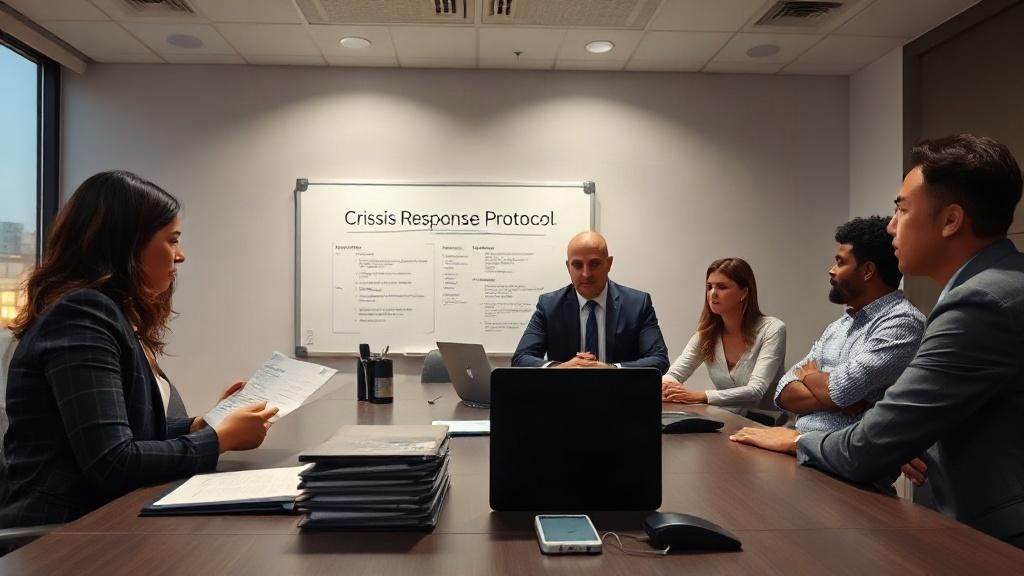
A crisis communication plan is a documented, pre-approved framework that tells your team exactly who speaks, what they say, and how fast they move when something goes wrong. Bold Thinkers Group has built and tested these plans across 50+ real-world crisis engagements — and the pattern is always the same: organizations without a written plan lose control of their narrative within the first hour.
That first hour is where reputations are made or broken.
The Core Definition: What a Crisis Communication Plan Actually Is
A crisis communication plan is not a PR document. It is an operational playbook.
It assigns roles, defines message approval chains, lists verified contact information, and maps out response protocols before a crisis ever starts. Think of it the way fire departments think of pre-incident planning — you build the plan when conditions are calm so your people can execute it when conditions are not.
HubSpot's research on organizational communications found that teams with documented response protocols resolve incidents up to 3x faster than those without them. That gap is not about talent. It is about preparation.
A well-built plan typically covers:
- Designated spokesperson(s) with backup contacts
- Pre-approved holding statements for 5–10 likely crisis scenarios
- A media contact list updated within the last 90 days
- Internal notification protocols (who gets called, in what order, within the first 15 minutes)
- A social media monitoring trigger system
- A post-crisis review schedule (typically within 72 hours of resolution)
What a Crisis Communication Plan Is Not
Many organizations confuse a crisis plan with a general communications strategy. They are not the same.
A communications strategy tells you how to market your organization. A crisis communication plan tells you how to protect it. One is built for growth. The other is built for survival.
A crisis plan is also not a legal document. It does not replace counsel. It does not make promises to regulators. It is a communications tool, and it should be treated as one.
McKinsey has noted that organizations that blend legal and communications response — rather than keeping them coordinated but separate — often slow their public response by 24–48 hours. That delay compounds reputational damage significantly.
A Crisis Communication Plan Example: What One Actually Looks Like
A practical crisis communication plan is not a 200-page binder. The most effective ones run 12–20 pages and include clear, scannable sections that work under pressure.
Here is a sample crisis communication plan structure used by government and private sector clients:
Section 1 — Crisis Definitions and Thresholds
Define what constitutes a Level 1, Level 2, and Level 3 crisis. For example, a Level 1 might be a single negative media inquiry. A Level 3 might be a facility incident with confirmed injuries and active media at the scene.
Section 2 — Response Team Roster
List every spokesperson, backup spokesperson, communications director, legal contact, and executive decision-maker. Include personal cell numbers. Update this list every 6 months.
Section 3 — Holding Statements
Pre-write 8–12 holding statements for likely crisis types. These are not full responses — they are the first 2–3 sentences your spokesperson delivers while the full response is being developed. A typical holding statement takes fewer than 90 seconds to deliver and buys your team 2–4 hours to gather facts.
Section 4 — Channel-Specific Protocols
Define how each channel responds — press release, social media, internal email, website banner — and who approves each one. For Tampa Bay government entities and public agencies, Florida's Division of Emergency Management publishes channel guidance that should be referenced in this section.
Section 5 — Media Relations Rules
Specify who is authorized to speak to media, who is not, and what the escalation path looks like if a reporter contacts an unauthorized staff member.
Section 6 — Post-Crisis Review
Schedule a debrief within 72 hours of resolution. Document what failed, what held, and what needs updating before the next incident.
Steps to Build Your Crisis Communication Plan
Most organizations have the pieces — they just have not assembled them under pressure-tested conditions. Here is how to start.
-
Audit your current vulnerabilities. List the 5–8 scenarios most likely to produce a public crisis for your organization. For a school district in Hillsborough County, that might be a student safety incident. For a healthcare provider in Pinellas County, it might be a data breach. For a manufacturer in Tampa, it might be a workplace injury with media present.
-
Assign a single plan owner. This person is responsible for keeping the document current, scheduling drills at least once every 12 months, and chairing every post-crisis review.
-
Write your holding statements now. Do not wait for a crisis to draft them. Pre-approved language that has passed legal review moves 4–6 times faster than language written under pressure.
-
Run a tabletop exercise. Simulate a Level 2 or Level 3 crisis with your response team. Time how long it takes to get a holding statement out the door. Most teams discover the answer is 45–90 minutes — far too slow.
-
Connect your crisis plan to your digital channels. Your website, social accounts, and email systems are frontline crisis tools. If they are not part of your plan, you have a gap. For guidance on managing real-time social response, see our post on Harnessing Social Media Analytics To Propel Small Business Growth.
How Public Agencies and First Responders Approach This Differently
FEMA's National Incident Management System (NIMS) requires public agencies to maintain an active Public Information Officer (PIO) function with documented communication protocols. That is not optional — it is federal doctrine.
Fire departments, law enforcement agencies, and emergency management offices across St. Petersburg, Tampa, and Hillsborough County operate under Joint Information Center (JIC) protocols during multi-agency incidents. Their crisis communication plans must account for unified messaging across multiple jurisdictions, all in real time.
Private sector organizations can learn from this model. Government PIOs are trained to release verified information within 15 minutes of an incident, update media every 30–60 minutes, and never speculate. That discipline does not come from instinct — it comes from a written plan and repeated practice.
For a closer look at how public safety agencies build public trust through disciplined communication, see What Makes Effective Fire Department Engagement Strategies.
Gartner has found that organizations with trained, certified spokespersons recover from reputational incidents 40% faster than those relying on untrained executives. Certification matters — not as a credential signal, but as a competency marker.
What Your Plan Must Account for That Most Templates Miss
Generic crisis communication plan templates miss three things that always surface in real incidents.
Speed asymmetry. Bad news travels at the speed of social media — roughly 15–30 minutes to reach local press. Your response chain may take 90 minutes to clear approvals. That gap is your reputation exposure window. Build a plan that closes it.
Spokesperson fatigue. Long incidents — anything running more than 6 hours — require spokesperson rotations. A plan that names only one spokesperson will fail by hour 8.
Digital amplification. A crisis in 2025 does not stay local. A Pinellas County incident can be trending nationally within 2 hours if the content is shareable. Your crisis communication plan must include a social listening trigger — typically a keyword alert set to notify your team when volume spikes more than 300% above baseline within any 1-hour window.
For clients who need their web presence to support crisis response — not slow it down — see Fire Department Community Outreach That Builds Trust for a model of how proactive digital communication builds the credibility that protects you before a crisis starts.
Frequently Asked Questions
Question: What is the difference between a crisis communication plan and a business continuity plan?
Answer: A business continuity plan addresses operational recovery — how you keep systems running. A crisis communication plan addresses narrative control — what you say publicly, to whom, and when. They are related but separate documents. Both should exist, and they should reference each other.
Question: How often should a crisis communication plan be updated?
Answer: Review your plan at minimum every 12 months. Update it immediately after any of the following: a real crisis, a significant staff change, a merger or acquisition, or a major shift in your digital presence. Contact lists and holding statements, in particular, go stale within 6–9 months.
Question: What is a holding statement in a crisis communication plan?
Answer: A holding statement is a short, pre-approved message — typically 2–4 sentences — that your spokesperson delivers while the full response is being assembled. It acknowledges the situation, signals that your organization is responding, and avoids speculation. A good holding statement takes under 60 seconds to read aloud and has been reviewed by legal before the crisis starts.
Question: Does a small business in Tampa need a crisis communication plan?
Answer: Yes. Any organization with employees, customers, social media accounts, or public-facing operations faces reputation risk. A small business in Tampa or St. Petersburg may not need a 20-page plan, but a 5-page document with a spokesperson, 4–5 holding statements, and a media protocol is the minimum viable protection.
A crisis communication plan is not paperwork. It is the difference between leading your narrative and chasing it.
Bold Thinkers Group builds these plans for government agencies, public safety organizations, healthcare providers, and private sector clients across Florida and beyond. Our crisis communications planning process is built on FEMA MPIO doctrine, real-world incident experience, and media strategy — not templates.
Call (813) 797-5004 or visit boldthinkersgroup.com to schedule a crisis communications assessment. We will review your current plan — or help you build one from scratch — before the next incident, not after it.
Reviewed by thinkBOLD | Bold Thinkers Group