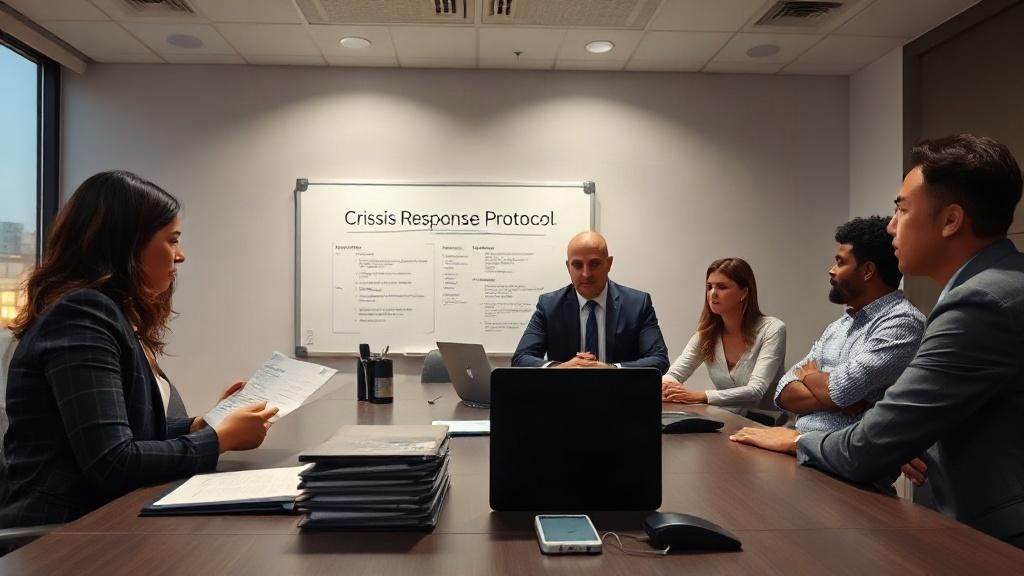
Most crisis plans fail before the crisis starts. They sit in a shared drive, unsigned and untested, built from a generic template that nobody on your team actually believes in. Bold Thinkers Group has worked through 50+ crisis engagements — and the pattern is always the same: organizations that had a real plan moved faster, said less wrong, and recovered faster.
Here is what a working crisis communication plan looks like, section by section.
Why Most Templates Fall Apart
A crisis communication plan example you find online typically covers the basics. It lists a spokesperson, names a few scenarios, and stops there.
That is not enough.
HubSpot research consistently shows that response speed is one of the top factors in audience trust during a public incident. Delays of even 1-2 hours can cost an organization weeks of recovery time.
The other problem: generic templates are not built for your context. A hospital in Tampa, FL faces different risks than a fire department in Hillsborough County. A nonprofit in St. Petersburg has different media relationships than a school district in Pinellas County. Your plan must reflect your actual stakeholders, your actual channels, and your actual chain of command.
The Core Sections Every Plan Must Include
A strong crisis communication plan has 6 core components. Each one should be no longer than it needs to be.
1. Risk Assessment and Scenario Library
List the 5-10 most likely crises your organization faces. For most Tampa Bay businesses and government entities, this includes:
- Severe weather events (hurricanes, flooding)
- Data or privacy incidents
- Employee misconduct allegations
- Service failures or public safety incidents
- Social media attacks or viral negative coverage
Each scenario needs a one-line trigger definition — the exact condition that activates the plan.
2. Crisis Communication Team Structure
Name specific people, not job titles. Titles change. People don't.
Your team needs at minimum:
- A primary spokesperson (trained and media-ready)
- A backup spokesperson
- A communications director or lead
- A legal liaison (internal contact, not counsel — your plan does not provide legal advice)
- A social media monitor
FEMA's Public Information Officer training guidelines require clear role assignments in any public-sector plan. Private organizations should hold themselves to the same standard.
3. Notification and Escalation Protocol
Who gets called first? Within how many minutes? On what platform?
Set hard time targets. A realistic example of a crisis communication plan escalation chain looks like this:
- 0-15 minutes: Internal incident confirmed, communications lead notified
- 15-30 minutes: Core crisis team assembled (in-person or virtual)
- 30-60 minutes: Draft holding statement reviewed and approved
- 60-90 minutes: First public statement issued
These are realistic targets. Missing them by more than 30 minutes typically means you are already behind the narrative.
4. Message Templates and Holding Statements
This is the section most templates skip. Do not skip it.
Pre-written holding statements for your top 5 scenarios save 45-60 minutes in a real crisis. They are not final statements. They are structured placeholders that acknowledge the situation, show concern, and promise follow-up — without admitting liability or speculating.
A basic holding statement template:
"We are aware of [incident type]. The safety of [stakeholder group] is our first priority. We are actively gathering information and will provide an update within [time frame]. For immediate questions, contact [designated channel]."
Adjust the language for each scenario in advance.
5. Channel and Platform Strategy
Where you speak matters as much as what you say. Different audiences live on different platforms.
If your crisis touches a local Tampa Bay audience, your channel strategy may include:
- Press release to Tampa Bay Times, FOX 13, ABC Action News, and Bay News 9
- Direct social media post on your primary platform (Meta/Facebook for most consumer-facing brands)
- Email to your stakeholder list
- Website statement page (update your homepage or create a dedicated response page)
Google's Search Quality Evaluator Guidelines emphasize that authoritative, timely information on your own domain builds trust during news events. Make sure your website reflects the most current statement within 30 minutes of any public release.
6. Recovery and Post-Crisis Evaluation
A plan without an ending is just a reaction plan. Build in a formal debrief — within 5 business days of resolution — that answers:
- What worked?
- What failed?
- What needs to change in the plan before next time?
Steps to Build Your Crisis Communication Plan
Follow these steps in order. Do not skip step 3.
- Audit your risks. List every scenario that has happened to your organization or a direct competitor in the past 5 years. That list is your starting threat model.
- Assign real names to real roles. Pull your org chart. Mark who speaks, who approves, who monitors. Get written sign-off from each person.
- Run a tabletop drill. Sit your crisis team down with a fictional scenario and run it in real time. You will find every gap in your plan within 90 minutes.
- Pre-write your holding statements. For each scenario in your library, draft a statement. Have legal review it (separately from your communications review).
- Distribute the plan. Print it. Put it in phones. Store it offline. A plan that requires internet access to access is a plan that may not be available when you need it most.
What a Complete Example of a Crisis Communication Plan Looks Like
A well-built plan for a mid-size organization in Florida typically runs 8-15 pages. It is not a binder. It is a field document.
A sample crisis communication plan should include:
- A one-page quick-reference card (laminated, posted in key locations)
- Full scenario library with triggers and draft messages
- Contact tree with personal cell numbers
- Media inquiry log template
- Social monitoring checklist
- Post-crisis evaluation form
Organizations that use this structure — instead of a downloaded generic template — are typically ready to respond within 30-45 minutes of a triggering event. Generic template users often need 2-4 hours just to locate the right contact.
For fire and law enforcement agencies that need crisis communications planning that meets FEMA and NIMS standards, the approach above maps directly to federal ICS/NIMS communication protocols.
You can also review how fire department community outreach builds trust during non-crisis periods — because the relationships you build before an incident shape how your messaging lands during one.
Tampa Bay Organizations: Local Context Matters
If you operate in Hillsborough, Pinellas, or the broader Tampa Bay region, your crisis plan needs to account for Florida-specific risks.
Florida law (Chapter 768) and public records statutes mean government and quasi-public entities face significant transparency obligations during a crisis. Your plan must account for rapid media scrutiny — Tampa Bay has an active local press corps that moves fast.
Hurricane season runs June 1 through November 30. If your organization has a physical location in Tampa, St. Petersburg, or anywhere along the Gulf Coast, your plan needs a weather-event protocol that pre-positions your messaging before landfall — not after.
HubSpot's research on social media response timing also applies here: brands that post within the first 60 minutes of a public incident receive significantly higher engagement and are more likely to control the narrative than those that wait.
To build social media readiness into your crisis response, see mastering social media content planning for success — the same planning discipline applies directly to crisis channel management.
And if your organization uses paid media to amplify stakeholder communications during or after a crisis, maximizing ROI with effective PPC strategies covers how to use targeted campaigns to reach the right audience at the right time.
Get a Plan That Holds Up When It Counts
A sample crisis communication plan template gives you a starting point. It does not give you a plan that works for your specific organization, your specific risks, or your specific market.
Bold Thinkers Group builds crisis communication plans grounded in FEMA MPIO standards — the same protocols used by public safety agencies across Florida and the country. We have run drills, written holding statements under live pressure, and stood next to spokespeople during real incidents.
Call (813) 797-5004 or visit boldthinkersgroup.com to schedule a free strategy session. We will assess your current plan — or the absence of one — and tell you exactly where you are exposed.
Frequently Asked Questions
Question: What should a crisis communication plan template include?
Answer: At minimum, it should include a risk and scenario list, a named crisis team with contact information, an escalation timeline, pre-written holding statements, a channel strategy, and a post-crisis evaluation process. Generic templates typically cover the first two and skip the rest.
Question: How long should a crisis communication plan be?
Answer: For most mid-size organizations, 8-15 pages is realistic. Anything shorter likely skips key sections. Anything longer than 20 pages typically becomes too complex to use under pressure. A one-page quick-reference card should accompany any full plan.
Question: How often should we update our crisis communication plan?
Answer: Review the plan at minimum every 12 months. Also review it after any significant organizational change — new leadership, new locations, new services — and immediately after any real or tabletop crisis event.
Question: Do we need a separate plan for social media?
Answer: Not a separate plan — but your main plan needs a dedicated social media section. It should name who monitors, who posts, what approval is needed before anything goes live, and what platforms are prioritized for which audience types. Many Florida organizations underestimate how fast local social media moves during a public incident.